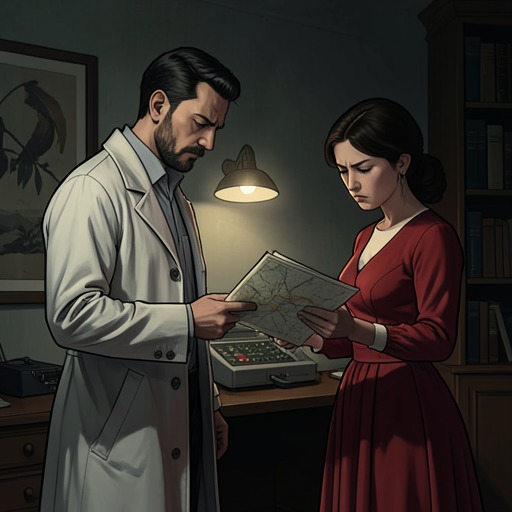
The narrator relinquishes his alien abilities and chooses to remain on Earth
The HumansAndrew Martin (the alien narrator) relinquishes his alien abilities in order to stay on Earth, turning what the hosts call a punishment into a freely chosen human life. The decision joins an intimate recognition of attachment to an explicit demand for autonomy: he will accept a body that suffers and dies rather than return to his former nature or allow his mind to remain under the hosts’ control.
The decision to stay
The choice takes shape in the garden, where the alien narrator recognizes that he could return simply by speaking one word in his native tongue: Home. He considers whether he is hesitating because he has not completed his task, then rejects that explanation. He has understood that he was never going to finish it. The night’s education has not brought the mission closer to success; it has shown him why the mission cannot be the reason to go back. His pause is instead a recognition that he is choosing risk and pain over their opposites, and that this preference marks a change in him.
Newton comes out into the garden and sniffs among the plants and flowers. The narrator expects the dog to bark and expose him, but Newton only looks at him and stays quiet. The narrator calls him a good dog and acknowledges that he loves him. This small encounter gives the choice an immediate, particular emotional context: the narrator is not weighing an abstract human existence against an abstract alien one, but finding himself attached to a living creature and unwilling, at that moment, to leave. His inability to say the word that would take him home is therefore more than a delay in carrying out his assignment.
The decision is tested again in the exchange that follows. Watching Isobel Martin, author of the unfinished novel, in the dark, the narrator wants to protect her and keep her safe. He gets out of bed with something to do and states that he is staying. His choice now has a purpose directed toward another person, rather than resting only on a rejection of the mission. When the hosts tell him he cannot remain because his gifts are not made for Earth and humans will become suspicious, he does not accept their warning as decisive. He asks instead to be disconnected.
A request without precedent
The hosts resist the request and say they cannot allow it. The narrator answers that they can, insisting that the gifts are not compulsory. He also gives a reason that is separate from the wish to pass among humans: he will not allow his mind to be interfered with. Remaining on Earth therefore entails more than choosing a location. It means refusing the hosts’ authority over his continued identity and asserting that the abilities they gave him are not an obligation he must keep.
The hosts press him on whether he really means to surrender the possibility of taking other forms and returning to his original nature. He says he does: he wants to be human, or as close to human as possible. They respond that no one in their history has ever asked to lose the gifts. His request is thus presented not as a routine adjustment but as an unprecedented break with the expectations of his society. His dry insistence that this is now a fact they must update turns the novelty of his decision back on the hosts: their history has not made the choice impossible.
The cost of becoming human
The hosts spell out the consequences before granting the request. He will be trapped in a body that cannot regenerate, will grow old and become ill, and will feel pain. More starkly, he will know that this suffering was chosen: unlike the species he wants to join, he will not be able to regard it as an unchosen condition. The narrator answers that he understands. The exchange makes clear that he is not mistaking humanity for a painless escape or asking to keep the benefits of his former existence while taking on a human name. He accepts bodily vulnerability as part of the life he wants.
The hosts call the outcome the ultimate punishment, adding that it remains punishment even when requested. They then disconnect him: the gifts are gone, and he is human. They warn that, if he declares himself to be from another planet, he will have no proof and will be considered insane. They also say that his place in the mission can easily be filled. The narrator counters that replacing him would waste resources because the mission has no point. His response refuses the hosts’ account of the event as merely a penalty and challenges the purpose of the assignment itself.
Separation and significance
After the disconnection, the narrator repeatedly tries to reach the hosts, asking whether they are listening and whether they can hear him. The exchange ends without a response in the supplied passage. The loss is therefore both physical and relational: he has surrendered the gifts, and the connection through which he argued with his own people is no longer available to him. His insistence that his mind must not be interfered with has been answered by a separation he knowingly requested.
The event reverses the apparent logic of the mission. The alien operative sent to Earth to carry out a task comes to understand that he will not complete it, and instead chooses the uncertain, painful existence that the hosts define as a punishment. His decision does not promise safety, acceptance, or proof of who he is; the hosts explicitly deny those assurances. Its significance lies in the choice itself: he accepts mortality and vulnerability as the price of staying, protecting someone he cares about, and becoming as human as he can. The narrator’s return is not a return to his former world. It is a deliberate refusal of that home and of the gifts that would make it possible.